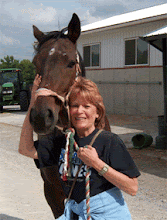
By Michael Makarian (HSUS)
http://www.huffingt onpost.com/ michael-markaria n/obstructionist -lawmakers_ b_238576. html
Saturday, July 18, 2009


Tuesday, June 2, 2009
Saving America's Horses

WFLF’s film label, Humanion Films is in production on a series of documentary films centering on the advancement of compassion to animals. Production began earlier this year on a feature documentary film, SAVING AMERICA’S HORSES which is in part inspired by the successful documentary audio program produced under WFLF’s radio label, WFL Endangered Stream Live.
About the Film
"Healthy vibrant horses are disappearing, never to be seen again. Find out where they are going, how they're getting there, what's really happening to them, and who's responsible.
The mission of Saving America's Horses, the film, is to inspire the apathetic and disposable mindset of today’s unassuming society into taking protective action for horses. This festival bound film follows the life stories of a few horses in a journey through time while taking a focused look into the horse slaughter business. This movie seeks to advance compassion for horses, raise awareness for their suffering, and expose the corrupt driving forces that serve to misinform the public. It's a potentially life changing film presentation that speaks to a broad demographic through inspirational anecdotes, riveting investigative reports, stunning audio/visuals and compelling solutions." - -Katia Louise
We have a compelling and riveting film in the works which promises to arouse strong public outcry in support of America’s horses. The film is attracting the attention and support of key industry names with several of the country’s most renowned and prominent horse experts on board and others still joining in.
Advisory Board members include Laura Allen, Dr. Nena Winand, John Holland, Paula Bacon, Shelley Abrams and Julie Caramante.
This feature presentation is anticipated to receive strong reviews and is moving forward quickly.
Websites:
Sneak a peek at the sleek Humanion Films website, for a glimpse at production insights.
Help us out by exchanging banners :-) Visit and explore the official film website, http://www.savingamericashorses.org/. Get banners, exchange banners, subscribe to the film blog updates, and add the film at Twitter, MySpace and Facebook.
Sneak a peek at the sleek Humanion Films website, for a glimpse at production insights.
Help us out by exchanging banners :-) Visit and explore the official film website, http://www.savingamericashorses.org/. Get banners, exchange banners, subscribe to the film blog updates, and add the film at Twitter, MySpace and Facebook.
Thanks for all you do for the horses,
Deb Lopez
and Associate Producer Humanion Films
Wednesday, April 8, 2009
Saturday, April 4, 2009
The Senate Introduces S727 - The Prevention of Equine Cruelty Act
The Senate Introduces S727 - The Prevention of Equine Cruelty Act.
Landrieu, Ensign Introduce Legislation to Stop Horse Slaughter
The Humane Society of the United States applauds U.S. Sens. Mary Landrieu, D-La., and John Ensign, R-Nev., for reintroducing legislation Thursday that would stop Mexico and Canada from killing and butchering tens of thousands of healthy American horses and prohibit the slaughter of American horses in the United States for sale to European and Asian countries. The passage of this critical legislation — The Prevention of Equine Cruelty Act — is a top priority for The HSUS and other animal welfare and equine rescue organizations, veterinarians and horse industry groups.
Original cosponsors of this legislation include Senators Barbara Boxer, D-Calif., Robert Byrd, D- W.Va., Benjamin Cardin, D-Md., Thomas Carper, D-Del., Susan Collins, R-Maine, Lindsay Graham, R-S.C., Ted Kennedy, D- Mass., John Kerry, D-Mass., Frank Lautenberg, D-N.J., Patrick Leahy, D-Vt., Carl Levin, D-Mich., Joseph Lieberman, D-Conn., John McCain, R-Ariz., and Robert Menendez, D-N.J.
"This bill could finally take American horses off the menu for good, and put an end to the disrespectful and inhumane treatment of a class of animals that have helped to shape and build American culture," said Wayne Pacelle, The HSUS' president and CEO. "The opponents of this legislation take a miserly and selfish attitude toward these creatures, and we can certainly do better than to ship horses hundreds, sometimes thousands of miles, in unbearable conditions to slaughter plants in Mexico and Canada."
State legislatures have acted to stop horse slaughter, shuttering the last remaining foreign-owned horse slaughter plants in the United States in 2007, and federal courts have upheld those state laws. But Congress has failed to act to stop the export of live horses to Canada and Mexico for slaughter, which is still occurring. More than 86,000 horses were sent across U.S. borders to slaughter in Canada or Mexico in 2008, surpassing the number of exports to date in 2007.
"America's horses are being beaten and dragged across the border into Mexico and Canada so that they can be inhumanely slaughtered for food. I will continue to fight in Congress to end this brutal practice and ensure that American horses will no longer be savagely slaughtered for human consumption," Sen. Landrieu said.
"The time to put an end to the practice of slaughtering horses in America is long overdue," Sen. Ensign said. "Horses have an important role in the history of our country, particularly the West, and they deserve our protection. As a senator and a veterinarian, I am committed to doing what I can for these magnificent animals." Sen. Ensign is the only veterinarian serving in the U.S. Senate.
In January, House Judiciary Committee Chairman Rep. John Conyers, D-Mich., and Rep. Dan Burton, R-Ind., introduced the House version of the Prevention of Equine Cruelty Act, H.R. 503. Past congressional actions on horse slaughter have demonstrated a strong, bipartisan desire to prohibit the killing of horses for human consumption. In the 109th Congress, legislation to stop horse slaughter passed the Senate by a more than two-to-one margin and passed the House numerous times by a margin of more than 100 votes. But in the 110th Congress, prior legislation, H.R. 503, introduced by Reps. Jan Schakowsky, D-Ill., Ed Whitfield, R-Ky., Nick Rahall, D-W.Va., and John Spratt, D-S.C, and S. 311, introduced by Sens. Landrieu and Ensign, was not enacted because it was blocked by House committee leaders and Western senators.
Animal advocates hope the Prevention of Equine Cruelty Act will advance quickly in the House and Senate in the 111th Congress.
Butchering horses is a particularly cruel end for these loyal and trusting creatures. The HSUS documented the cruelty and abuse when investigators followed "killer buyers" who transport horses thousands of miles from auctions to feedlots to interstate highways. The HSUS also documented a barbaric method of slaughter on a kill floor in Juarez, Mexico, in which thousands of horses were, and still are, stabbed with short knives, leaving them paralyzed and unable to breathe. Horses may still be conscious when they are hoisted up by a chain and when their throats are slit. Recent documentation uncovered by horse welfare advocates demonstrates that the U.S. plants were equally inhumane and riddled with gross abuse. There is no humane way to slaughter horses for food and no reason to prop up this ailing and unpopular industry.
The HSUS is joined by members of Congress, the National Show Horse Registry, American Horse Defense Fund, Veterinarians for Equine Welfare, United States Equine Sanctuary & Rescue and more than 500 endorsing organizations along with the majority of Americans in support of a ban on the slaughter of horses for human consumption.
Timeline:
September 2008 – House Judiciary Committee passes H.R. 6598 by voice vote after majority reject multiple poison pill amendments.
July 2008 – Conyers and Burton introduce H.R. 6598, legislation amending Title 18 to prohibit horse slaughter for human consumption as a form of equine cruelty.
September 2007 - A three-judge panel from the U.S. Court of Appeals for the Seventh Circuit unanimously upholds the Illinois state law banning the slaughter of horses for human consumption in that state.
May 2007 – Illinois governor signs H.B. 1711, banning horse slaughter in Illinois.
May 2007 – The U.S. Supreme Court announces that it denies to consider an appeal of the lower court decision upholding Texas' ban on the sale of horsemeat for human consumption.
April 2007 – The U.S. House of Representatives passes H.R. 249 to restore a decades-old ban on the commercial sale and slaughter of wild horses first enacted under the Wild and Free-Roaming Horses and Burros Act of 1971. House vote: 277-137
April 2007 – The U.S. Senate Commerce Committee votes 15-7 to approve S. 311 to ban horse slaughter and exports of horses for slaughter.
March 2007 - A federal district court orders the U.S. Department of Agriculture to stop inspecting horsemeat at the Cavel International slaughter plant, effectively closing the last operating horse slaughtering operation in the United States.
March 2007 – The United States Court of Appeals for the Fifth Circuit affirms a decision upholding a Texas state law banning the sale of horsemeat for human consumption.
September 2006 – The U.S. House of Representatives passes H.R. 503, the American Horse Slaughter Prevention Act. The 109th Congress adjourns before the Senate can consider the bill. House vote: 263-146
September 2005 – The U.S. Senate approves the Ensign-Byrd Amendment to the FY 2006 Agriculture Appropriations Bill to prohibit the use of tax dollars to pay for inspections of horsemeat. Senate vote: 69-28
June 2005 – The U.S. House of Representatives approves the Sweeney-Spratt-Rahall-Whitfield Amendment to the FY 2006 Agriculture Appropriations Bill to prohibit the use of tax dollars to pay for inspections of horsemeat. House vote: 269-158
May 2005 – The U.S. House of Representatives approves the Rahall-Whitfield Amendment to the FY 2006 Interior Appropriations Bill to restore federal protections from commercial sale and slaughter to wild horses and burros. House vote: 249-159. The provision is stripped in conference from the final bill.
Video footage from The HSUS' horse slaughter investigations is at video.hsus.org.
Landrieu, Ensign Introduce Legislation to Stop Horse Slaughter
The Humane Society of the United States applauds U.S. Sens. Mary Landrieu, D-La., and John Ensign, R-Nev., for reintroducing legislation Thursday that would stop Mexico and Canada from killing and butchering tens of thousands of healthy American horses and prohibit the slaughter of American horses in the United States for sale to European and Asian countries. The passage of this critical legislation — The Prevention of Equine Cruelty Act — is a top priority for The HSUS and other animal welfare and equine rescue organizations, veterinarians and horse industry groups.
Original cosponsors of this legislation include Senators Barbara Boxer, D-Calif., Robert Byrd, D- W.Va., Benjamin Cardin, D-Md., Thomas Carper, D-Del., Susan Collins, R-Maine, Lindsay Graham, R-S.C., Ted Kennedy, D- Mass., John Kerry, D-Mass., Frank Lautenberg, D-N.J., Patrick Leahy, D-Vt., Carl Levin, D-Mich., Joseph Lieberman, D-Conn., John McCain, R-Ariz., and Robert Menendez, D-N.J.
"This bill could finally take American horses off the menu for good, and put an end to the disrespectful and inhumane treatment of a class of animals that have helped to shape and build American culture," said Wayne Pacelle, The HSUS' president and CEO. "The opponents of this legislation take a miserly and selfish attitude toward these creatures, and we can certainly do better than to ship horses hundreds, sometimes thousands of miles, in unbearable conditions to slaughter plants in Mexico and Canada."
State legislatures have acted to stop horse slaughter, shuttering the last remaining foreign-owned horse slaughter plants in the United States in 2007, and federal courts have upheld those state laws. But Congress has failed to act to stop the export of live horses to Canada and Mexico for slaughter, which is still occurring. More than 86,000 horses were sent across U.S. borders to slaughter in Canada or Mexico in 2008, surpassing the number of exports to date in 2007.
"America's horses are being beaten and dragged across the border into Mexico and Canada so that they can be inhumanely slaughtered for food. I will continue to fight in Congress to end this brutal practice and ensure that American horses will no longer be savagely slaughtered for human consumption," Sen. Landrieu said.
"The time to put an end to the practice of slaughtering horses in America is long overdue," Sen. Ensign said. "Horses have an important role in the history of our country, particularly the West, and they deserve our protection. As a senator and a veterinarian, I am committed to doing what I can for these magnificent animals." Sen. Ensign is the only veterinarian serving in the U.S. Senate.
In January, House Judiciary Committee Chairman Rep. John Conyers, D-Mich., and Rep. Dan Burton, R-Ind., introduced the House version of the Prevention of Equine Cruelty Act, H.R. 503. Past congressional actions on horse slaughter have demonstrated a strong, bipartisan desire to prohibit the killing of horses for human consumption. In the 109th Congress, legislation to stop horse slaughter passed the Senate by a more than two-to-one margin and passed the House numerous times by a margin of more than 100 votes. But in the 110th Congress, prior legislation, H.R. 503, introduced by Reps. Jan Schakowsky, D-Ill., Ed Whitfield, R-Ky., Nick Rahall, D-W.Va., and John Spratt, D-S.C, and S. 311, introduced by Sens. Landrieu and Ensign, was not enacted because it was blocked by House committee leaders and Western senators.
Animal advocates hope the Prevention of Equine Cruelty Act will advance quickly in the House and Senate in the 111th Congress.
Butchering horses is a particularly cruel end for these loyal and trusting creatures. The HSUS documented the cruelty and abuse when investigators followed "killer buyers" who transport horses thousands of miles from auctions to feedlots to interstate highways. The HSUS also documented a barbaric method of slaughter on a kill floor in Juarez, Mexico, in which thousands of horses were, and still are, stabbed with short knives, leaving them paralyzed and unable to breathe. Horses may still be conscious when they are hoisted up by a chain and when their throats are slit. Recent documentation uncovered by horse welfare advocates demonstrates that the U.S. plants were equally inhumane and riddled with gross abuse. There is no humane way to slaughter horses for food and no reason to prop up this ailing and unpopular industry.
The HSUS is joined by members of Congress, the National Show Horse Registry, American Horse Defense Fund, Veterinarians for Equine Welfare, United States Equine Sanctuary & Rescue and more than 500 endorsing organizations along with the majority of Americans in support of a ban on the slaughter of horses for human consumption.
Timeline:
September 2008 – House Judiciary Committee passes H.R. 6598 by voice vote after majority reject multiple poison pill amendments.
July 2008 – Conyers and Burton introduce H.R. 6598, legislation amending Title 18 to prohibit horse slaughter for human consumption as a form of equine cruelty.
September 2007 - A three-judge panel from the U.S. Court of Appeals for the Seventh Circuit unanimously upholds the Illinois state law banning the slaughter of horses for human consumption in that state.
May 2007 – Illinois governor signs H.B. 1711, banning horse slaughter in Illinois.
May 2007 – The U.S. Supreme Court announces that it denies to consider an appeal of the lower court decision upholding Texas' ban on the sale of horsemeat for human consumption.
April 2007 – The U.S. House of Representatives passes H.R. 249 to restore a decades-old ban on the commercial sale and slaughter of wild horses first enacted under the Wild and Free-Roaming Horses and Burros Act of 1971. House vote: 277-137
April 2007 – The U.S. Senate Commerce Committee votes 15-7 to approve S. 311 to ban horse slaughter and exports of horses for slaughter.
March 2007 - A federal district court orders the U.S. Department of Agriculture to stop inspecting horsemeat at the Cavel International slaughter plant, effectively closing the last operating horse slaughtering operation in the United States.
March 2007 – The United States Court of Appeals for the Fifth Circuit affirms a decision upholding a Texas state law banning the sale of horsemeat for human consumption.
September 2006 – The U.S. House of Representatives passes H.R. 503, the American Horse Slaughter Prevention Act. The 109th Congress adjourns before the Senate can consider the bill. House vote: 263-146
September 2005 – The U.S. Senate approves the Ensign-Byrd Amendment to the FY 2006 Agriculture Appropriations Bill to prohibit the use of tax dollars to pay for inspections of horsemeat. Senate vote: 69-28
June 2005 – The U.S. House of Representatives approves the Sweeney-Spratt-Rahall-Whitfield Amendment to the FY 2006 Agriculture Appropriations Bill to prohibit the use of tax dollars to pay for inspections of horsemeat. House vote: 269-158
May 2005 – The U.S. House of Representatives approves the Rahall-Whitfield Amendment to the FY 2006 Interior Appropriations Bill to restore federal protections from commercial sale and slaughter to wild horses and burros. House vote: 249-159. The provision is stripped in conference from the final bill.
Video footage from The HSUS' horse slaughter investigations is at video.hsus.org.
Monday, March 16, 2009
CONGRESS MUST ACT NOW!! SAVE AMERICA'S HORSES
Congress Must Act Now: Draconian Horse Killing Bill CHICAGO, (EWA) - A vote in the Montana House Thursday on a Draconian horse killing bill demands immediate action by the Congress. The Equine Welfare Alliance urges immediate passage of the Prevention of Equine Cruelty Act of 2009. State legislation that has been introduced and passed in Montana and elsewhere to build horse slaughterhouses on US soil are in direct violation of federal law.Illinois, in particular, is attempting to completely remove veterinarian inspections. This is a clear message stating that the US does not care what drugs the horses have ingested, what diseases they carry and more importantly, what the consequences will be to the consumers of the horse meat. In Montana, the bill was written to prohibit citizens from bringing suit against the building of a plant based on environmental issues unless a fee is paid equaling 20% of the construction cost. This is a violation of the constitutional rights of every American citizen to have access to the courts in a fair, equitable and above all, affordable arena. Congress can no longer ignore that the basis of the campaign unleashed by pro horse slaughter supporters and organizations is fraught with lies and scare tactics. Organizations and individuals promoting horse slaughter have not provided one piece of solid evidence that justifies or supports the need for horse slaughter. Their constant media blitzes consist of false articles portraying a tsunami of abandoned horses and dismissal of irrefutable evidence provided by Freedom of Information Act (FOIA). The documentation of unspeakable abuse and cruelty extracted reluctantly from the United States Department of Agriculture proves the need to forever prohibit killing horses for human consumption in foreign markets. The media campaign is misleading at best, and downright dishonest, at worst. The spin includes calling horse slaughter processing, harvesting, humane euthanasia and recycling, in an attempt to transform the reality into something more palatable. These words belie the reality that living creatures are strung upside down, as their throats are cut for a slow death, while hooves are sawed off from their bodies. The horse is still living and often conscious during this “humane” process. Anti slaughter advocates are accused of being employed by The Humane Society of the United States (HSUS) and People for the Ethical Treatment of Animals (PETA) or being city “folk” that don’t understand the horse industry. Nowhere does the reader see one fact or any type of data to support the claims. Increasingly, supporters of horse slaughter squawk that anti-slaughter advocates are vegans determined to end animal agriculture in the United States. Noting could be further from the truth. Horses, mules, and other equines built the Capital building in Washingtonwhere their fate will be debated. These beasts of burden carried lumber, brick and mortar, to build the White House where we implore President Obama to sign the act. The American Veterinarian Association (AVMA) and the Federal Drug Administration (FDA) classifies horses as companion animals, not livestock. Law enforcement rides service animals, hardly food stock animals. Livestock do not participate in the Triple Crown. Livestock are not used in therapy to help returning soldiers with head injuries, regain their balance. Livestock do not participate in presidential and military funerals. Every function horses perform in our society is that of a service animal. It is time for Congress to take a stand and say enough is enough. Equines should be recognized as service animals and Congress must enact HR 503 immediately to end the cruelty and abuse American horses endure to satisfy European diners. It is time for Congress to remove the reward for irresponsible breeding and the owners that do not take responsibility for equines they chose to own or breed. We urge caring Americans to pester your Legislators relentlessly until they pass and President Obama signs legislation putting an end to the obscene cruelty of horse slaughter. |
Monday, February 9, 2009
HORSE SLAUGHTERERS' STRATEGY REVEALED
Just in From Animal Law Coalition: 2/9/09
http://www.animallawcoalition.com/horse-slaughter/article/682
Horse Slaughterers' Strategy Revealed
Posted Feb 9, 2009 by lauraallen
Horse Slaughter
State legislators have been introducing pro horse slaughter resolutions on behalf of foreign investors anxious to defeat H.R. 503.
H.R. 503, which is pending in Congress would stop them from using American horses for horsemeat served as a delicacy in fine restaurants primarily in parts of Asia, Europe and South America.
These resolutions are worded almost identically.
The resolutions proclaim that there is an increase in "unwanted" or "unusable" horses, as many as 100,000 or more annually, because of the closing of U.S. horse slaughter facilities in 2007. They claim the closing of U.S. slaughter houses in 2007 had "significant economic impact on the...equine industry". These resolutions call for "processing" or "harvesting" horses, euphemisms for "slaughter", which they describe as "humane". They claim slaughter can be managed through inspections and regulations.
These resolutions, if approved by the state legislatures, would be sent to Congress, as the state's position that H.R. 503 should be defeated.
It is important to voice your opposition to these resolutions. These resolutions are pending in these states:
Arizona, S.C.M. 1001 Find your Arizona legislators here. Contact all Arizona state House and Senate members.
Utah, H.J.R. 7, which has already passed the state House and has been approved by a Senate committee. Contact all Utah state Senators.
Missouri, HCR 19 in the House and SCR 8 in the state senate. These resolutions also call for opening a horse slaughter house in that state. Find your Missouri legislators here. Find all Missouri state representatives and senators. HCR 19 is pending before the state Agri-Business Committee and SCR 8 will be voted on by the state Senate Rules, Joint Rules, Resolutions, and Ethics Committee.
South Dakota, S.C.R. 2 has already passed the state House by a vote of 63-1. A separate, second bill, S.B. 114, asks the South Dakota state legislature to spend $100,000 on a study "of the feasibility, viability, and desirability of establishing and operating an equine processing facility in the state. Find your South Dakota state senators here. Find email addresses for all South Dakota state senators here. Find contact information for all South Dakota state representatives and senators here.
ND S.C.R. 4021 will be heard on Feb. 12, 2009 at 11 a.m. by the Senate Agriculture committee. Fax the committee at 701-328-3615 or email lcouncil@nd.gov A second bill, H.B. 1496 has already been approved by a legislative committee. The committee approved $75,000 in North Dakota for a study of possible markets for horse meat, applicable laws and funding for a horse slaughter facility there. Find all North Dakota state senators here. Find all House members here.
Wyoming, H.J.R. 8 has already passed committee. Find all Wyoming legislators here.
Minnesota, S.F. 133 is currently in the state Senate Agriculture and Veterans Committee. Find your Minnesota state senator and representative. Find all Minnesota state senators and representatives.
Kansas, HCR 5004 Find your Kansas legislators here. Find all Kansas state House and Senate members.
Arkansas H.C.R. 1004, also calls for incentives and support for opening of horse slaughter houses nationally and in the state. This bill has already passed in the state House and is in the Senate Committee on Agriculture, Forestry and Economic Development Find here all Arkansas state senators, including yours if you live there.
In Illinois Rep. Jim Sacia has introduced a bill, as he did last session for the repeal of the 2007 state law banning horse slaughter. That state law helped shut down the horse slaughter facility in Dekalb, Illinois.
Rep. Sacia's bill, H.B. 583, would also allow horses destined for slaughter for human consumption to be shipped into the state for slaughter with no certificate of veterinary inspection contrary to current state law governing horses. 510 ILCS 65/4 The new law would also exempt downed, sick, diseased, lame or disabled horses from the requirements of the Humane Care for Animals Act governing animals in this condition. 510 ILCS 70/5, 7.5
This means Rep. Sacia and the interests he represents in the horse slaughter underworld understand that horse slaughter is brutal and cruel and so would want to exempt their sordid practice from the animal cruelty laws and inspection requirements.
Contact Illinois state House and Senate members and urge them to vote NO on H.B. 583 and keep horse slaughter out of Illinois.
The horse slaughterers' strategy
These resolutions and bills are a not-so-subtle ploy by the foreign investors that own horse slaughter houses to defeat H.R. 503 which would ban the sale, transport, and possession of horses in interstate and foreign commerce for slaughter for human consumption.
Even without H.R. 503, horse slaughter cannot occur legally in the U.S. There is no point in states appropriating tax dollars for studies when currently horse slaughter for human consumption is not allowed in the U.S. These resolutions will simply insure horse slaughterers can continue to take American horses to Mexico or Canada for slaughter.
There is also another goal: to make horse slaughter acceptable to Americans and, in fact, create a market in the U.S. for the consumption of horsemeat. The resolution proposing the North Dakota study says as much. If Americans begin eating horsemeat, the theory is that Congress will be forced to fund ante-mortem inspections. Under current law because these required inspections are not funded, horse slaughter is not legal in the U.S. For more on this.....
Keep in mind when the remaining 3 horse slaughter houses in the U.S. closed in 2007, they were owned by foreign companies, Dallas Crown, Inc.; Cavel International, Inc. and Beltex Corp., which now operates a horse slaughter house in Mexico, Empacadora de Carnes de Fresnillo.
Even when there were horse slaughter houses in the U.S., they were part of a horse meat industry that was only 0.001% of the U.S. meat industry. The foreign-owned U.S. horse slaughterhouses paid little in income taxes. One facility paid $5 in federal taxes on $12 million in sales. These slaughter houses paid no export taxes, meaning the U.S. government effectively subsidized the sale of horse meat to consumers generally in parts of Asia, South America and Europe.
The profits went to the foreign investors. The communities where horse slaughter houses were located were left with horrific odors of dying and dead horses, blood literally running down the streets, and illegally dumped waste. There is no economic or other benefit to these states in subsidizing horse slaughter. Just the opposite. It is akin to supporting dog fighting rings.
Horse slaughter is also not a means of controlling numbers of "unwanted horses". This is a myth perpetuated by the horse slaughter industry that is simply repeated over and over again as in these resolutions. Horse slaughter is a multi million dollar a year business that is driven by a demand for horse meat. Kill buyers buy horses at auction for slaughter, and the USDA has said over 92% of American horses slaughtered, are healthy, not old, sick, injured, or neglected. These horses were not unwanted; they were simply sold at auction, and their owners had no control over who purchased them. Without the kill buyers who skulk around horse auctions, looking for the best potential horse meat, most of these horses would be purchased by others or end up in rescues or sanctuaries.
As John Holland, a free lance writer and researcher on horse slaughter and consultant for Americans Against Horse Slaughter, has explained, "Kill buyers do not go around the country like dog catchers gathering ‘unwanted horses' as a public service."
As Americans Against Horse Slaughter points out, "Just over 100,000 horses were slaughtered in the U.S. in 2006. If slaughter were no longer an option and these horses were rendered or buried instead, it would represent a small increase in the number of horse being disposed of in this manner - an increase that the current infrastructure can certainly sustain. Humane euthanasia and carcass disposal is highly affordable and widely available. The average cost of having a horse humanely euthanized and safely disposing of the animal's carcass is approximately $225, while the average monthly cost of keeping a horse is approximately $200."
Also, the horse slaughter industry actually encourages the over breeding of horses. Because owners can make money from the brutal slaughter of their horses, they have an incentive to over breed. As Paul Sorvino put it, "37% of those horses are going to be slaughtered because they couldn't run fast enough....So, it's run for your life." If the slaughter of horses for human consumption is illegal, there is no reward for over breeding.
Sadly, pro-slaughter groups have disseminated disinformation in the media to convince the public that without horse slaughter, there will be large numbers of abandoned, abused and neglected horses. (Even if that were true, which it is not, it is not clear how substituting one form of cruelty for another is somehow a solution.)
Indeed, these reports in the media have proven to be unfounded. A study released last year showed a decrease in horse abuse and neglect cases following closure of the last U.S. horse slaughter house in 2007. Any abandoned or neglected horses are not a result of a lack of horse slaughter houses.
Historically, there have not been increases in abandoned, neglected or abused horses following closures of horse slaughter houses. In 2002 the Illinois slaughter house burned to the ground and was out of commission for some time. Reports of abandoned, abused and neglected horses in the Illinois area were actually on the rise in the 2 years before the fire but decreased afterwards.
Remember the number of horses slaughtered in the U.S. dropped significantly from over 300,000 annually in the 1990s to 66,000 in 2004. There was no notable increase during that time of abandoned, abused or neglected horses.
When California banned horse slaughter in 1998, there was no rise in cases of cruelty or neglect to horses. In fact, there was a 39.4% decrease initially and that rose to 88% eventually in horse thefts. (What does that tell you about this "business"?)
Also, from 2004-2007 5000 horses were imported into the U.S. for slaughter. If horse slaughter occurs because of all the unwanted horses, why would these horse slaughter businesses need to import them? The answer is, of course, they wouldn't. Horse slaughter has nothing to do controlling numbers of unwanted horses. It is a business driven by a demand for horse meat primarily as a delicacy in foreign countries.
As Americans Against Horse Slaughter puts it, "The ‘surplus horse population' [argument] is a scare tactic."
Horse slaughter is also in no sense humane euthanasia. That much has been established by documents recently released in response to a FOIA request. The captive bolt gun used in the U.S. slaughterhouses did not typically render horses senseless before slaughter. The slaughter houses never bothered to restrain the horses' heads or use only trained personnel to operate the gun.
As John Holland has explained, "In its 2000 report on methods of Euthanasia, the AVMA stated that the captive bolt gun should not be used on equines unless head restraint could be assured. This is because of the relatively narrow forehead of equines, their head shyness and the fact that the brain is set back further than in cattle for which the gun is intended. It is difficult for an operator to assure proper placement of the gun.
"No slaughter house ever found a practical way to restrain the heads of the horses, so by the AVMA's very definition, the process was not acceptable. The result was a very large number of ineffective stuns. These misplaced blows undoubtedly caused severe pain until a stunning or fatal blow was delivered. "
Imagine the pain and terror experienced by horses as bolts were repeatedly fired at their heads many times by untrained operators. Many times horses were still conscious when they were then hoisted upside down for slaughter. For more information on the brutality of horse slaughter in the U.S., click here to read the July 25, 2006 testimony of Christopher J. Heyde, Deputy Legislative Director for Animal Welfare Institute, before the U.S. House Subcommittee on Commerce, Trade and Consumer Protection. Click here to read testimony offered during a Congressional hearing in 2008 about the cruelty of horse slaughter.
Also, listen here to a discussion on WFL Endangered Stream Live Talk Radio about horse slaughter by Laura Allen, Executive Director of Animal Law Coalition; John Holland, journalist and consultant for Americans Against Horse Salughter; Dr. Nena Winand, DVM with Veterinarians for Equine Welfare and Paula Bacon, former mayor of Kaufman, Tx and leader of the fight to shut down the horse slaughter facility that operated there until 2007. (Download this broadcast!)
Then contact your U.S. representative and urge him or her to vote YES on the Conyers-Burton Prevention of Equine Cruelty Act of 2009, H.B. 503.
Also, tell your representative to vote YES on H.R. 305, the Horse Transportation Safety Act, which will put an end to all transports of horses on double decked trailers.
Where You Can Find More Information on Horse Slaughter
Read Frequently Asked Questions About Unwanted Horses and the AVMA's Policy on Horse Slaughter
Read Veterinarians for Equine Welfare's Horse Slaughter - Its Ethical Impact and Subsequent Response by the Veterinary Profession
http://www.animallawcoalition.com/horse-slaughter/article/682
Horse Slaughterers' Strategy Revealed
Posted Feb 9, 2009 by lauraallen
Horse Slaughter
State legislators have been introducing pro horse slaughter resolutions on behalf of foreign investors anxious to defeat H.R. 503.
H.R. 503, which is pending in Congress would stop them from using American horses for horsemeat served as a delicacy in fine restaurants primarily in parts of Asia, Europe and South America.
These resolutions are worded almost identically.
The resolutions proclaim that there is an increase in "unwanted" or "unusable" horses, as many as 100,000 or more annually, because of the closing of U.S. horse slaughter facilities in 2007. They claim the closing of U.S. slaughter houses in 2007 had "significant economic impact on the...equine industry". These resolutions call for "processing" or "harvesting" horses, euphemisms for "slaughter", which they describe as "humane". They claim slaughter can be managed through inspections and regulations.
These resolutions, if approved by the state legislatures, would be sent to Congress, as the state's position that H.R. 503 should be defeated.
It is important to voice your opposition to these resolutions. These resolutions are pending in these states:
Arizona, S.C.M. 1001 Find your Arizona legislators here. Contact all Arizona state House and Senate members.
Utah, H.J.R. 7, which has already passed the state House and has been approved by a Senate committee. Contact all Utah state Senators.
Missouri, HCR 19 in the House and SCR 8 in the state senate. These resolutions also call for opening a horse slaughter house in that state. Find your Missouri legislators here. Find all Missouri state representatives and senators. HCR 19 is pending before the state Agri-Business Committee and SCR 8 will be voted on by the state Senate Rules, Joint Rules, Resolutions, and Ethics Committee.
South Dakota, S.C.R. 2 has already passed the state House by a vote of 63-1. A separate, second bill, S.B. 114, asks the South Dakota state legislature to spend $100,000 on a study "of the feasibility, viability, and desirability of establishing and operating an equine processing facility in the state. Find your South Dakota state senators here. Find email addresses for all South Dakota state senators here. Find contact information for all South Dakota state representatives and senators here.
ND S.C.R. 4021 will be heard on Feb. 12, 2009 at 11 a.m. by the Senate Agriculture committee. Fax the committee at 701-328-3615 or email lcouncil@nd.gov A second bill, H.B. 1496 has already been approved by a legislative committee. The committee approved $75,000 in North Dakota for a study of possible markets for horse meat, applicable laws and funding for a horse slaughter facility there. Find all North Dakota state senators here. Find all House members here.
Wyoming, H.J.R. 8 has already passed committee. Find all Wyoming legislators here.
Minnesota, S.F. 133 is currently in the state Senate Agriculture and Veterans Committee. Find your Minnesota state senator and representative. Find all Minnesota state senators and representatives.
Kansas, HCR 5004 Find your Kansas legislators here. Find all Kansas state House and Senate members.
Arkansas H.C.R. 1004, also calls for incentives and support for opening of horse slaughter houses nationally and in the state. This bill has already passed in the state House and is in the Senate Committee on Agriculture, Forestry and Economic Development Find here all Arkansas state senators, including yours if you live there.
In Illinois Rep. Jim Sacia has introduced a bill, as he did last session for the repeal of the 2007 state law banning horse slaughter. That state law helped shut down the horse slaughter facility in Dekalb, Illinois.
Rep. Sacia's bill, H.B. 583, would also allow horses destined for slaughter for human consumption to be shipped into the state for slaughter with no certificate of veterinary inspection contrary to current state law governing horses. 510 ILCS 65/4 The new law would also exempt downed, sick, diseased, lame or disabled horses from the requirements of the Humane Care for Animals Act governing animals in this condition. 510 ILCS 70/5, 7.5
This means Rep. Sacia and the interests he represents in the horse slaughter underworld understand that horse slaughter is brutal and cruel and so would want to exempt their sordid practice from the animal cruelty laws and inspection requirements.
Contact Illinois state House and Senate members and urge them to vote NO on H.B. 583 and keep horse slaughter out of Illinois.
The horse slaughterers' strategy
These resolutions and bills are a not-so-subtle ploy by the foreign investors that own horse slaughter houses to defeat H.R. 503 which would ban the sale, transport, and possession of horses in interstate and foreign commerce for slaughter for human consumption.
Even without H.R. 503, horse slaughter cannot occur legally in the U.S. There is no point in states appropriating tax dollars for studies when currently horse slaughter for human consumption is not allowed in the U.S. These resolutions will simply insure horse slaughterers can continue to take American horses to Mexico or Canada for slaughter.
There is also another goal: to make horse slaughter acceptable to Americans and, in fact, create a market in the U.S. for the consumption of horsemeat. The resolution proposing the North Dakota study says as much. If Americans begin eating horsemeat, the theory is that Congress will be forced to fund ante-mortem inspections. Under current law because these required inspections are not funded, horse slaughter is not legal in the U.S. For more on this.....
Keep in mind when the remaining 3 horse slaughter houses in the U.S. closed in 2007, they were owned by foreign companies, Dallas Crown, Inc.; Cavel International, Inc. and Beltex Corp., which now operates a horse slaughter house in Mexico, Empacadora de Carnes de Fresnillo.
Even when there were horse slaughter houses in the U.S., they were part of a horse meat industry that was only 0.001% of the U.S. meat industry. The foreign-owned U.S. horse slaughterhouses paid little in income taxes. One facility paid $5 in federal taxes on $12 million in sales. These slaughter houses paid no export taxes, meaning the U.S. government effectively subsidized the sale of horse meat to consumers generally in parts of Asia, South America and Europe.
The profits went to the foreign investors. The communities where horse slaughter houses were located were left with horrific odors of dying and dead horses, blood literally running down the streets, and illegally dumped waste. There is no economic or other benefit to these states in subsidizing horse slaughter. Just the opposite. It is akin to supporting dog fighting rings.
Horse slaughter is also not a means of controlling numbers of "unwanted horses". This is a myth perpetuated by the horse slaughter industry that is simply repeated over and over again as in these resolutions. Horse slaughter is a multi million dollar a year business that is driven by a demand for horse meat. Kill buyers buy horses at auction for slaughter, and the USDA has said over 92% of American horses slaughtered, are healthy, not old, sick, injured, or neglected. These horses were not unwanted; they were simply sold at auction, and their owners had no control over who purchased them. Without the kill buyers who skulk around horse auctions, looking for the best potential horse meat, most of these horses would be purchased by others or end up in rescues or sanctuaries.
As John Holland, a free lance writer and researcher on horse slaughter and consultant for Americans Against Horse Slaughter, has explained, "Kill buyers do not go around the country like dog catchers gathering ‘unwanted horses' as a public service."
As Americans Against Horse Slaughter points out, "Just over 100,000 horses were slaughtered in the U.S. in 2006. If slaughter were no longer an option and these horses were rendered or buried instead, it would represent a small increase in the number of horse being disposed of in this manner - an increase that the current infrastructure can certainly sustain. Humane euthanasia and carcass disposal is highly affordable and widely available. The average cost of having a horse humanely euthanized and safely disposing of the animal's carcass is approximately $225, while the average monthly cost of keeping a horse is approximately $200."
Also, the horse slaughter industry actually encourages the over breeding of horses. Because owners can make money from the brutal slaughter of their horses, they have an incentive to over breed. As Paul Sorvino put it, "37% of those horses are going to be slaughtered because they couldn't run fast enough....So, it's run for your life." If the slaughter of horses for human consumption is illegal, there is no reward for over breeding.
Sadly, pro-slaughter groups have disseminated disinformation in the media to convince the public that without horse slaughter, there will be large numbers of abandoned, abused and neglected horses. (Even if that were true, which it is not, it is not clear how substituting one form of cruelty for another is somehow a solution.)
Indeed, these reports in the media have proven to be unfounded. A study released last year showed a decrease in horse abuse and neglect cases following closure of the last U.S. horse slaughter house in 2007. Any abandoned or neglected horses are not a result of a lack of horse slaughter houses.
Historically, there have not been increases in abandoned, neglected or abused horses following closures of horse slaughter houses. In 2002 the Illinois slaughter house burned to the ground and was out of commission for some time. Reports of abandoned, abused and neglected horses in the Illinois area were actually on the rise in the 2 years before the fire but decreased afterwards.
Remember the number of horses slaughtered in the U.S. dropped significantly from over 300,000 annually in the 1990s to 66,000 in 2004. There was no notable increase during that time of abandoned, abused or neglected horses.
When California banned horse slaughter in 1998, there was no rise in cases of cruelty or neglect to horses. In fact, there was a 39.4% decrease initially and that rose to 88% eventually in horse thefts. (What does that tell you about this "business"?)
Also, from 2004-2007 5000 horses were imported into the U.S. for slaughter. If horse slaughter occurs because of all the unwanted horses, why would these horse slaughter businesses need to import them? The answer is, of course, they wouldn't. Horse slaughter has nothing to do controlling numbers of unwanted horses. It is a business driven by a demand for horse meat primarily as a delicacy in foreign countries.
As Americans Against Horse Slaughter puts it, "The ‘surplus horse population' [argument] is a scare tactic."
Horse slaughter is also in no sense humane euthanasia. That much has been established by documents recently released in response to a FOIA request. The captive bolt gun used in the U.S. slaughterhouses did not typically render horses senseless before slaughter. The slaughter houses never bothered to restrain the horses' heads or use only trained personnel to operate the gun.
As John Holland has explained, "In its 2000 report on methods of Euthanasia, the AVMA stated that the captive bolt gun should not be used on equines unless head restraint could be assured. This is because of the relatively narrow forehead of equines, their head shyness and the fact that the brain is set back further than in cattle for which the gun is intended. It is difficult for an operator to assure proper placement of the gun.
"No slaughter house ever found a practical way to restrain the heads of the horses, so by the AVMA's very definition, the process was not acceptable. The result was a very large number of ineffective stuns. These misplaced blows undoubtedly caused severe pain until a stunning or fatal blow was delivered. "
Imagine the pain and terror experienced by horses as bolts were repeatedly fired at their heads many times by untrained operators. Many times horses were still conscious when they were then hoisted upside down for slaughter. For more information on the brutality of horse slaughter in the U.S., click here to read the July 25, 2006 testimony of Christopher J. Heyde, Deputy Legislative Director for Animal Welfare Institute, before the U.S. House Subcommittee on Commerce, Trade and Consumer Protection. Click here to read testimony offered during a Congressional hearing in 2008 about the cruelty of horse slaughter.
Also, listen here to a discussion on WFL Endangered Stream Live Talk Radio about horse slaughter by Laura Allen, Executive Director of Animal Law Coalition; John Holland, journalist and consultant for Americans Against Horse Salughter; Dr. Nena Winand, DVM with Veterinarians for Equine Welfare and Paula Bacon, former mayor of Kaufman, Tx and leader of the fight to shut down the horse slaughter facility that operated there until 2007. (Download this broadcast!)
Then contact your U.S. representative and urge him or her to vote YES on the Conyers-Burton Prevention of Equine Cruelty Act of 2009, H.B. 503.
Also, tell your representative to vote YES on H.R. 305, the Horse Transportation Safety Act, which will put an end to all transports of horses on double decked trailers.
Where You Can Find More Information on Horse Slaughter
Read Frequently Asked Questions About Unwanted Horses and the AVMA's Policy on Horse Slaughter
Read Veterinarians for Equine Welfare's Horse Slaughter - Its Ethical Impact and Subsequent Response by the Veterinary Profession
Tuesday, January 27, 2009
LIVE FEED ON SATURDAY FEB. 7TH 3PM With John Holland (Senior Analyst for AAHS) and Paula Bacon and Laura Allen!
Saving America's Horses on WFL Endangered Stream Live, Talk Radio for the Protection of Animals
The Hidden Cruelty of Horse Slaughter and the Fight for Federal Support to Make it Stop.
Host Katia Louise interviews an expert panel of guests on the continuing sordid practice of horse slaughter as currently sustained by the United States. Horses suffer unimaginable cruel treatment in the process of their transport out of the US to Mexico and Canada where they experience barbaric slaughter. Listeners will learn the truth about one of America's darkest secrets and how to take action to stop this cruel and rapidly growing business of exports through the support of current, yet disregarded bills lingering in Congress for the past 8 years.
Guests include Paula Bacon representing Americans Against Horse Slaughter and as former mayor of Kaufman TX, she helped to shut down the Dallas Crown, a US horse slaughter plant now operating in Mexico, among the worst malign abusers of cruelty in this brutal practice. Also joining us is the renown author on the issue of horse slaughter, John Holland; senior analyst for Americans Against Horse Slaughter. Holland has authored and coauthored studies on the relationship of horse slaughter to the rate of abuse and neglect in horses and has written dozens of articles on the subject of horse slaughter and its politics. Plus we have Animal Law Attorney, Laura Allen of the Animal Law Coalition who's been fiercely active in the support of getting legislature passed for the Prevention of the Equine Cruelty. These panelists are fighting to abolish horse slaughter and the export of horses for slaughter with support more stringent enforcement of laws to prevent abuse and neglect.
Call-in number: (646) 727- 2170. Calls will be accepted live during the show. The chat room at the show's WFL Endangered Stream Live Blog Talk Radio page will be open throughout the broadcast for simultaneous discussion and to help answer questions. Registered listeners may connect and talk straight from their computer from anywhere in the world. (learn more)
Listen live on Saturday, Feb 7th at 3pm (PST) at WFL Endangered Stream Live Blog Talk Radio.
Listen anytime on demand.
Links:
http://wflendangeredstreamlive.org/showlineup.html
http://www.blogtalkradio.com/wflendangeredstreamlive/2009/02/07/Saving-Americas-Horses
Subscribe to:
Posts (Atom)