Wednesday, February 16, 2011

Horses Will Finally Get Their Voice!


Long Awaited Film, “Saving America’s Horses” to Launch in March

February 16, 2011 - Steve Long

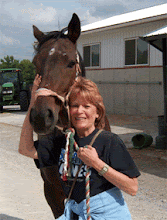
HOUSTON, (Horseback) – America is days away from the long awaited March premier of Saving America’s Horses, A Nation Betrayed  in Los Angeles. The movie is by educator and documentary filmmaker Katia Louise, and Humanion Films, a project of Wild for Life Foundation.
“The film is geared to pique the interest of a wide demographic, across multiple cultures and continents,  so we are anticipating that it will run for quite some time and hopefully mark the end of an inhumane era for America’s horses and perhaps the beginning in a shift in cultural values,” she toldHorseback Magazine.
Louise has produced, directed and anchored over a dozen investigative audio documentaries with an international audience spanning over 100 countries. Her work in cinema includes the documentary films “Spirit Brothers”,  about the endangered wolves of Northern America, “A Day in Tribute” and “Celebration of Life.”
 Savng America’s Horses, A Nation Betrayed has been accepted into several film festivals.
“Our production team has a selection process with factors to consider like programming and budgets,” she said. “The first festival screening is scheduled through the Los Angeles Women’s International Film Festival which takes place March 25th – 31st this year.”
 Making a film about horses fulfills a childhood passion.
“Horses have been a part of my life since I was a young girl and I love them,” Louise said. “
That passion turned into action when she learned of horse slaughter for human consumption.
“For me, the minute I found out what was happening to them, that’s all it took and the more I learned the more I wanted to help them,” she said.
Leaders of the large equine advocacy movement have embraced the film and its producer from the beginning.
“There has been an enormous amount of support from the horse advocates,” she said. “They are the people who primarily care about the horses and they want to insure the humane treatment and welfare of both wild equines and domestic breeds.”
Louise says she has attempted to present the issue of both the horse processing industry and the controversial wild horse issue without bias
“We are presenting both sides of the issue through the film and we have extended an invitation to both sides in order to present the differing viewpoints as best possible.”
Thus far, while the film decidedly will have a pro-horse slant, “So far we have not had any push back from the “other side.”
The producer predicts a dismal future for the North American Mustang.
“The film presents a focus on the slaughter issue as it relates to both wild and domestic equines,” Louise says. “As far as the wild horses go, knowing what I know to be true about the BLM and their policies and activities; the days of the wild horses as we have always known them to be, wild and free in this country, are numbered at best under the current regime. That’s why the issue regarding wild horses needs to be brought to the public eye before it’s too late for the horses.”
The fill will feature only equine advocates who quietly do their work as unknowns, but can also boast appearances by outspoken celebrities that who frequently speak out for the horse. They include Michael Blake, Paul Sorvino, Linda Gray, Tippi Hedren, Ginger Kathrens, Nick Zito, Jane Velez-Mitchel, The Barbi Twins, Amy and Raelyn Nelson. Other celebrities are yet to be announced.
“Plus we have several very well recognized experts on board,” Louise said.
 The producer hopes her film will be a catalyst for making a better world for the horse.
“The ultimate goal is to inspire change by exposing the truth,” she said.

For the entire article, please logon here: http://horsebackmagazine.com/hb/archives/6679

Sunday, December 19, 2010

Wyoming Resident Files Complaint Against State Rep Sue Wallis

CHICAGO - Wyoming resident, Patricia Fazio, Ph.D. has filed a complaint with state officials, requesting an investigation of alleged violations of ethics laws and securities fraud by Wyoming State Rep. Sue Wallis (R-Campbell).
Animal Law Coalition (ALC), Equine Welfare Alliance (EWA) and Habitat for Horses Advisory Council (HfHAC) applaud Dr. Fazio and join in the call for authorities to investigate Wallis' activities.
The complaint alleges Rep. Wallis is improperly and even fraudulently abusing her position as a Wyoming legislator. The complaint further alleges that Rep. Wallis not only neglected to recuse herself or disclose her personal financial interest in votes, but that she has actually "sponsored" bills that would materially benefit her or her family.
Wallis has publicly claimed to be forming a business under the name, Unified Equine LLC, which she says will slaughter horses and sell the meat within Wyoming. At the same time, in her capacity as a legislator, she is promoting legislation that would deregulate, promote and favor horse slaughter operations.
Wallis published a web page enticing people to invest in Unified Equine LLC which turned out to be a non-existent entity for months. Also according to the Complaint, the apparent solicitation for investors may have violated other federal and state securities laws.
The fraud on investors may go deeper: Not only is commercial horse slaughter for human consumption illegal in the U.S., as the complaint states, "there is no market in the U.S. for human consumption of horsemeat, nor is there a market for use of horsemeat in pet food". To be a viable business within Wyoming with its population of 544,270, such a facility "would have to ...sell approximately 10,000,000 pounds of horsemeat per year, or 18 pounds for every man, woman and child in the state".
Wallis has also sponsored the "Food Freedom Act", a bill that would eliminate all regulation of food sold directly to the consumer. The bill was dubbed by one health department official as a "fraud".
The bill could allow Wallis' slaughter business to sell contaminated horse meat directly to Wyoming consumers without any form of government oversight, testing or inspection. American horses are not raised for food and are typically administered drugsincluding carcinogens that, according to the FDA, are prohibited in horsemeat sold as human food.
The deceptively named Food Freedom Act would likely also benefit Wallis' family's business which sells homemade jellies and syrups, among other food goods.
The complaint further calls into question Wallis' use of 501(c)3 charitable designations to solicit funds for her promotion of horse slaughter. Wallis has a number of ever-changing, interrelated organizations and websites that solicit funds for allegedly "charitable" or "educational" purposes. But Wallis' efforts appear to be purely political, focused on passing laws from which she can benefit personally and financially.
It is not clear where donations are actually going, and Dr. Fazio requests an investigation into possible commingling of tax exempt and non-tax exempt funds. Wallis has also openly touted her position as a legislator to solicit funding for pro-horse slaughter interests.
Most recently, Wallis has announced she is holding a pro-horse slaughter "summit" in Las Vegas with a hefty price tag for attendees. She was to announce the winner of a raffle for a new pick-up truck. Then according to the complaint, Wallis announced she may not be able to buy the truck and asked raffle participants if she could just keep the money from ticket sales. According to the complaint, Wallis may be "running an unlicensed lottery, and at worst she has attempted to defraud those who bought the tickets at $100 apiece."
According to the Wyoming Minority Floor Leader Rep. W. Patrick Goggles, the complaint has been referred to the Legislative Service Office for review. Dr. Fazio also requested the Wyoming Attorney General as well as the Secretary of State's ethics disclosure and compliance offices to investigate these allegations.

Thursday, October 14, 2010

NATIONAL CALL-IN DAY FOR OUR HORSES - TUESDAY, OCT 19TH, 2010

Dear Friends,


The following organizations have joined together to ask you to call on Speaker of the House Nancy Pelosi on Tuesday, October 19th and Ask her to schedule a vote NOW on the Prevention of Equine Cruelty Act (H.R. 503), legislation to ban the slaughter of American horses for human consumption. Schedule the vote NOW. Tell her she has the power to end immense suffering by scheduling the vote NOW during the remaining session of Congress THIS YEAR! NOW is the time for her to step up and do this. Tell Speaker Pelosi that this bill has 183 bipartisan cosponsors in the House, 28 in the Senate, and tremendous public support.

After you call Speaker Pelosi,(202) 225-0100 or her San Francisco office, (415) 556-4862, call on Senate Majority LeaderSen. Harry Reid702-388-5020 / Fax: 702-388-5030, and Assistant Majority Leader Sen. Dick Durbin(202) 224-2152 or fax (202) 228-0400to schedule a vote on the senate version, S.B. 727. Don’t wait. Do it now. For the horses.

For more information please go to Animal Law Coalition here: http://www.animallawcoalition.com/horse-slaughter/article/1443


Friday, October 8, 2010

What We Can Learn From Secretariat


http://www.humanesociety.org/news/news/2010/10/secretariat.html
October 7, 2010

What We Can Learn from Secretariat

by Scott Beckstead

The story of legendary horse Secretariat is a classic American tale: Against the odds and defying all skeptics, an underdog became a champion and national hero, inspiring millions. Disney's new movie, Secretariat promises to underscore the special role that horses occupy in the American imagination. It also presents an opportunity to celebrate all that we love about our horses and to think again about our responsibilities to these amazing creatures.

A well-earned retirement

Secretariat spent his life surrounded by a loving owner and millions of adoring fans. His owner rewarded his record-setting performance with a pampered retirement and a long, full life. And while few horses could hope for the luxuries he enjoyed, all horses deserve the opportunity he was given: a chance at a second career. In Secretariat’s case, that meant a long life as a breeding sire.

Other horses, after retiring from the track, have proved they can excel at pleasure riding, competitive show jumping, or competitive dressage.

A second career ... or slaughter?

Sadly, though, too many are never given a chance to prove themselves off the track. As long as horse slaughter remains legal in the United States, the greedy and unscrupulous will make a quick profit off horses.

Race horses, who have been trained to trust people, suffer the ultimate betrayal when they are sold at auction then trucked in terrible conditions to foreign slaughter plants, where they are killed and butchered for consumption abroad. Secretariat’s brother, Straight Flush, was awaiting the slaughter truck when rescued by a benefactor who recognized him as the brother of the red chestnut racing star. One wonders how many thousands of Secretariat’s descendants weren’t rescued from that horrible fate.

From the Derby to the slaughterhouse

Even winning the Kentucky Derby is no guarantee that a horse will be spared the horrors of the slaughter plant: witness Ferdinand, winner of the 1986 Kentucky Derby, who was butchered in a foreign slaughter plant after failing to sire winning foals.

The industry takes steps

Thankfully, the racing industry has taken some important steps to ensure the welfare of race horses. A growing number of tracks and racing associations have adopted a zero-tolerance policy toward horse slaughter, banning any trainer that sells horses for slaughter.


Other industry groups have dedicated resources to finding good homes for retired racers. The California Thoroughbred Breeders Association, for example, has created the California Equine Retirement Foundation, dedicated to making sure that every race horse gets a second chance at another career and a good, loving home.

Working toward a happy ending for all

As we celebrate Secretariat’s victories on the big screen, let’s keep in mind that for most race horses, the story does not end at the finish line or the winner’s circle. For too many, the story ends in heartbreak and tragedy.

It is our hope that with the release of this film, the American people will reflect on the effort our race horses make for us in the name of sport and entertainment—and how we will repay that effort when they step off the track for the last time.


Scott Beckstead is The HSUS’s Senior State Director for Oregon and Equine Protection Specialist

Friday, September 3, 2010

The Perfect Time to End the Slaughter of American Horses

The Perfect Time to End the Slaughter of American Horses
Editorial by John Holland


At the moment, the news is rife with stories about the level of equine neglect in the United States, with many of the articles blaming the "unintended consequences" of closing the US horse slaughter plants and calling for them to be reopened. But in reality, we are coming up on a once in a lifetime opportunity to get rid of this abominable practice once and for all. To understand this apparent paradox, one needs to get past unsubstantiated myths to the real forces at play in the market.
First, one needs to understand that it is completely impossible to blame the current glut of excess horses on the closing of the slaughter plants because the closings simply sent the horses over the Mexican and Canadian borders for slaughter. In 2006, the year before the closings, 142,740 American horses were slaughtered, and that number only dropped by 14% the year the plants were closed. By 2008, slaughter was back to the second highest level in almost ten years.

Next, it is necessary to understand what really causes neglect, and that is unemployment. After years of studying the relationship between neglect rates and slaughter volumes, I had concluded that there was no relationship whatever. Then I looked at the rates of neglect in Illinois in comparison with unemployment in the state. The correlation was striking.

[GRAPH]

Like most such revelations, it should have been expected, but it was still striking. It perfectly explains the mystery of how the number of American horses slaughtered in the US between 1989 and 2002 could have dropped from 377,078 to 77,713 (almost 80%) with no negative impact on either neglect or horse prices.

This correlation also tells us what we can expect as unemployment goes both up and down. At the moment the US is experiencing high unemployment with national rates hovering just under 10%. As predicted from the above graph, this is causing a high rate of neglect.

So why can I say with complete confidence that we are coming up on the perfect opportunity to end slaughter without significantly impacting the horse market?

There is a second factor at work. As the market for horses remains depressed, many breeders are throwing in the proverbial towel. Every day brood mares and stallions are being sold at auction and on internet sites like Craig's List. This is temporarily increasing the supply and further depressing prices.

The result of this further depression in prices is to convince even more breeders to quit producing. Statistics show breeding is down dramatically in virtually all breeds. The Jockey Club, for example, recently predicted the 2011 foal crop will be the lowest since 1973. Similarly, the American Quarter Horse Association's annual reports shows a 15% drop in revenue for new registrations between 2006 and 2009.

This trend will continue until the economy begins to recover significantly, or the market eventually reaches a new balance. Slaughter cannot help reduce the over supply of horses because the horse meat market is also depressed. Although the export of US slaughter horses in 2008 brought the annual slaughter back its level before the plant closures, the subsequent recession caused a 25.8% drop in exports between 2008 and 2009. The reduction in demand for slaughter horses will likely continue as the effects of new EU drug residue regulations begin forcing horses to be quarantined for 6 months prior to slaughter.

But these two trends are about to merge and provide a wonderful opportunity to end slaughter with little or no impact on the market. As the smaller foal crops reach market age, there will be a reduction supply, and when the economy finally begins to recover, it will bring with it more carrying capacity (demand) for horses. With less supply and more homes available, the number of surplus horses will dip to a record low.

Moreover, there will be a move toward quality. In a recent interview, a struggling breeder in Canada complained she had to sell her horses to slaughter because the market was so low, but in the very next sentence she explained "You have to breed 100 horses to get two good ones." Clearly that business model has been a big part of the problem that gotten us to this point, but few "lotto breeders" appear to be surviving the current market.

Only a deep and prolonged recession could have brought us this opportunity and we have certainly been experiencing just that. It would be a tremendous shame if we missed this coming opportunity. Recent auction reports indicate that prices are already beginning to increase.
What is needed is for congress to pass HR 503 / S 727, banning the slaughter and export to slaughter of American horses. This action could be placed in abeyance until a trigger was reached of unemployment dropping significantly (perhaps under 8%). The result would be a smooth transition to a much more humane equine industry.

Horse slaughter is not a "necessary evil", merely an evil. Now is our opportunity to resign this practice to the dust bin of American history.

John Holland is a freelance writer, the author of three books and an industrial consultant in the field of intelligent automation and knowledge engineering. He frequently writes on the subject of horse slaughter from his small farm in the mountains of Virginia, where he lives with his wife, Sheilah, and their 12 equines. Holland is president of the Equine Welfare Alliance and serves as senior analyst for Americans Against Horse Slaughter, an organization composed entirely of volunteers.

Tuesday, August 10, 2010


Please take this time to set-up a meeting with your Members of Congress
 
 While Congress is home for the August recess, many members of Congress and candidates running for office use this time to host town hall meetings, attend civic events, political rallies, and meet with constituents at their in-district office.

During this time they are out talking to their constituents and this is a great opportunity to remind them how important HR503/S727 "The Prevention of Equine Cruelty Act" is to you and to the American people.

A lot is at stake in the November elections. It is important that lawmakers and candidates remember the important role our horses play in our country.  Please ask your Members of Congress to support the passage of HR503 and S727 "The Prevention of Equine Cruelty Act".  Any blockage of this legislation will have a devastating effect on our culture as we know it.  EU countries are banning meat tainted by drugs that are commonly given to horses which include, antibiotics, wormers and bute. While horsemeat is not sold in the US, it is exported from Canada and Mexico to the EU and to Japan, where it is considered a delicacy.  Many of the horses that are brutally slaughtered in Mexican and Canadian slaughter houses come from the US.

Help us end the suffering of our American Horses. How can a country that was built on the backs of our horses ignore the people who wish to give them the quality of life they deserve?

Please, Rise Up and make that meeting for the horses!
 
 Thank you for all you do.

  • Rise Up
  • Get Involved
  • Join The Movement
Take Action:
1) Request a meeting with your Representative and Senators to discuss "The Prevention of Equine Cruelty Act"

2) Most of your Members of Congress will be attending events in your area during this recess. This is a good opportunity to speak face to face in a location convenient for you.


To Find your Members of Congress, please log on here: